

Lessons from America: Education & Parent Power
How American conservatives defeated the ‘woke’ school Blob

A quiet revolution is unfolding in America, largely unnoticed. While everyone’s eyes are on Washington and the White House, so-called “school choice” is steadily reshaping American education, state by state.
Ever since Milton Friedman in the 1950s, US conservatives have talked about giving parents the power to allocate their child’s share of taxpayer education-funding to a school of their choice – even a private school. For decades, no one did much about it.
Ronald Reagan, as president, was happy to leave in place the newly-created federal Department of Education. Instead of extending parent power, President George W Bush increased the role of the federal government with his No Child Left Behind initiative.
Conservative reformers thought in terms of improving education provision and outcomes, rather than parent power. That meant pushing for more publicly-funded, but independently-operated charter schools. More than three million American children are now in such schools.
In some states, like my own Mississippi, conservatives focused on how children were taught, insisting on the use of phonics for reading. As an antidote to decades of progressive “whole language” teaching, it worked, with improvements in literacy.
But as for school choice, little actually happened. Then Covid hit.
One of the unforeseen effects of shutting down schools was to force parents to think about the way their children were being taught. Deference to teachers and the local school board evaporated. Suddenly, millions of families that had never bought into the idea of school choice wanted to be in the driver’s seat.
Shortly afterwards, Arizona, which already had a limited school-choice programme, and West Virginia decided to give families control over their child’s share of state education funds. Families could request to have the money paid into a dedicated Education Savings Account for their child and then allocate the funds to approved providers.
Despite teething problems and legal challenges, the programmes have proved popular, especially with low-income households. Suddenly, they had alternatives to a failing local school and could make choices that previously only middle-class Americans could afford.
Now more than a dozen states have followed suit, with some, such as Louisiana and Texas, only recently passing the legislation.
As you would expect in America, each state does it differently. Many school-choice states have opted for the Education Savings Account approach, giving families that want one a dedicated account into which their education funds are paid. Others, such as Oklahoma and Idaho, have achieved something similar by giving families a tax credit. Five years on from the pandemic, millions of American children now have access to school choice.
It is striking how many school-choice states are Southern – Alabama, Arkansas, Florida, Louisiana, North Carolina, Oklahoma, Tennessee, Texas.
But the effect is likely to be enormous. In a state like Arkansas, ordinary families can now apply to have about $6,000 a year to spend on their child’s education. According to the Private School Review, the average annual private school tuition fee in the state is around $10,000. We could therefore well start to see many families that could never previously afford it go private.
That may well prompt public schools to improve their offerings. If families start to switch, public schools, for the first time in years, might have to raise their game. Some local education officials might even start to run things for the benefit of students, rather than for those on the school superintendent’s payroll or for the powerful teaching unions.
Interestingly, there is evidence that parents are embracing school choice not necessarily because of concern about standards, but because of culture. There is an appetite to change the content of the education that children receive, with millions of Americans fed up with “woke” ideology in the classrooms. Rather than making futile complaints to the local school board, parents can now switch schools. The Classic Learning Test is also already emerging as a credible alternative to the “woke” ACT as a gold standard of testing in US education.
Parent power, in other words, is starting to steer American education in a conservative direction in all sorts of ways.
Like their cousins on the other side of the Atlantic, British conservatives, too, thought of education reform in terms of changing outcomes and provision. As a Member of Parliament when David Cameron was leader of the opposition, I vividly remember trying to persuade Michael Gove, his shadow education secretary, of the need to give parents control over their child’s share of education spending.
Instead, in government, the Conservatives preferred to build upon the Blair government’s reforms, expanding the number of autonomous academies. Like so many American conservatives pre-Covid, ministers focused on provision, creating a British version of American charter schools, the so-called free schools. They were more excited about ensuring phonics were used in the classroom than they were about the idea of giving parents control.
Of course, without parent power to sustain the change, once Gove and his colleagues left office, things fizzled out. Ministers who followed him, such as Nicky Morgan, appeared to be bamboozled by an education “Blob”, allergic to rigour. Then, of course, came a Labour government. In a single year, they have started to reverse many of the improvements Gove and others spent years advancing.
If only, like America, British conservatives had realised that the key to improved outcomes in education is not ministerial fiat, but families having control over their share of the money. And school choice has the added benefit of challenging the dominant progressive culture in the education system. It could well be making America inherently more conservative.
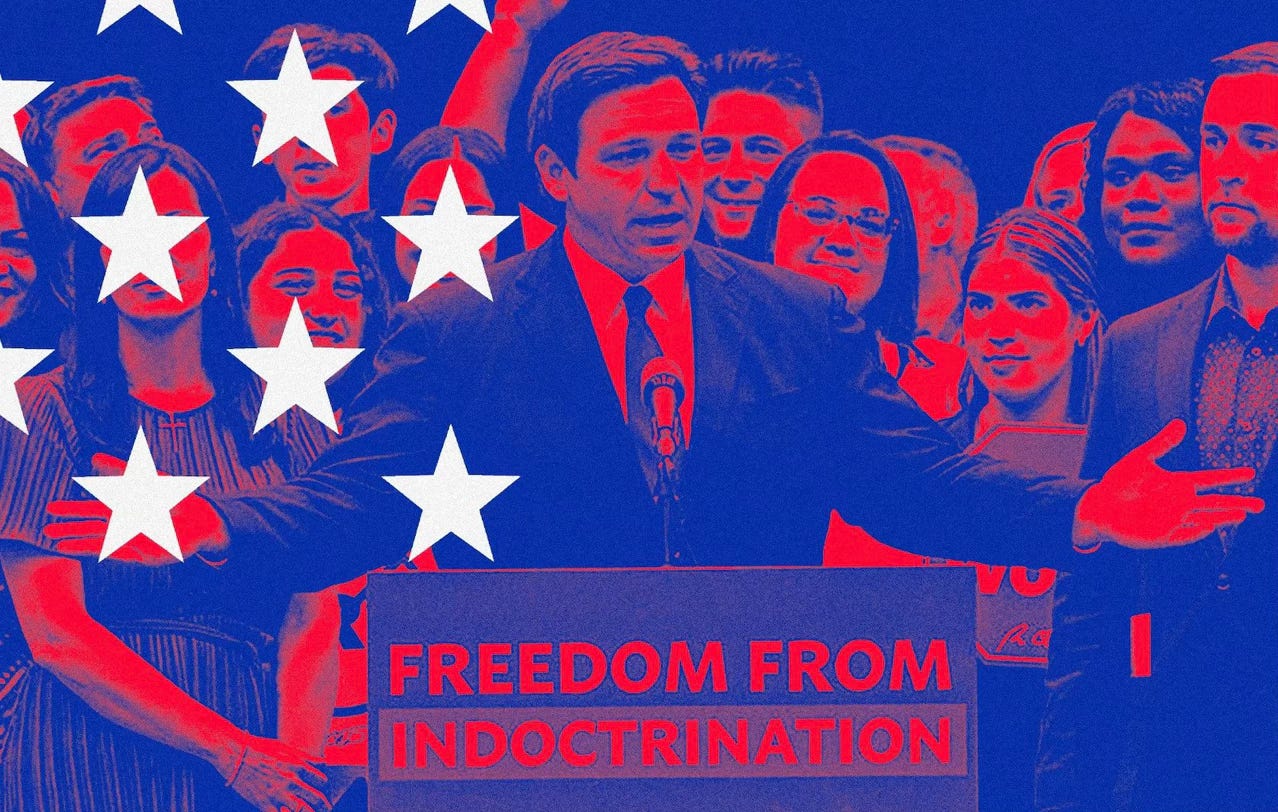
Twenty years ago, the giant southern states of Texas and Florida were swing states. George Bush only won the latter by a hair’s breadth. Today? Texas and Florida are solidly conservative. Hispanic voters in those states, once seen as Left-leaning, have moved to the Right. One of the factors behind this is a desire among parents to access better educational opportunities for their children via school choice.
When Margaret Thatcher gave working people the right to buy their council house in the 1980s, she was not just making them middle class. She was creating a new constituency of support. School choice in states like Florida is starting to do something remarkably similar. As Hispanic voters benefit from school choice, they have started to become a core part of the conservative coalition.
If only British conservatives had done something similar, they and the education system might both be in better shape today. It’s not too late for them to learn the lessons from the school-choice movement sweeping America.
Thanks. You are a great writer. Glad you are appreciated in America as is my son. Love for you to meet up with him.